Emergency Department Simulation Mannequin

Emergency Department Simulation Mannequin

Contact Us

If you want to learn more about this priority or would like to discuss how to support it, please contact us at 705-876-5000.

Helping PRHC emergency teams stay ready for you and your loved ones

As a Level III Trauma Centre serving more than 600,000 people across Peterborough and the surrounding region, PRHC’s Emergency Department (ED) cares for some of the area’s sickest and most critically injured patients.

When an ill or injured patient arrives at the ED, there isn’t time to hesitate. Emergency teams have to make lifesaving decisions under pressure. Whether it’s a severe allergic reaction, a traumatic injury after a serious accident, or a senior whose fall suddenly becomes life threatening, preparation beyond a healthcare provider’s own medical training matters. Simulation training, where team members work together through a mock scenario, has become essential to emergency care.

Every month, ED doctors, residents, nurses, students, respiratory therapists and partners such as EMS are led through a detailed simulation of a patient care situation. Using a specialized mannequin designed to mimic a patient, everyone participates in the training scenario as they would in real life. Then they review what went well and identify opportunities for improvement.

But the mannequin at the heart of training is more than a decade old, limiting the realism and effectiveness of simulation. New simulation mannequins feature advanced technology and better reflect the realities of modern emergency medicine. They can blink, breathe, bleed, speak, defibrillate, take injections into bones, veins and muscles, and respond to treatments in real time. All of these options create a more immersive learning experience. The more immersive and realistic the training, the more it stays with doctors, nurses and staff when every second counts.

You can help!

You can make a donation online and select to direct your gift to the Campaign for PRHC, or for more information, please call 705-876-5000.

Simulation isn't just about training individuals, it's about improving the entire system before a real patient is affected. It allows healthcare professionals to learn together, practice together and build confidence before they're caring for someone's loved one in a real emergency. A new, state-of-the-art simulation mannequin would strengthen teamwork and better prepare our staff to care for our community.
Emily Philips
PRHC Clinical Nurse Educator

Learn About Our Other Current Giving Priorities

Donors are helping transform the path from hospital to home with a new model of care for short-stay patients

On December 9, the Reactivation Care Centre opened its doors at Peterborough Regional Health Centre, providing patients with specialized care so they can return home safely. PRHC Foundation donors helped make this possible through $400,000 in funding. 

The 12-bed Reactivation Care Centre is helping PRHC patients navigate their next steps with a new treatment model. With a focus on seniors, the Centre supports patients through short-stay admissions, where each individual works towards specific goals so they can return home in safety and comfort.

“The Reactivation Care Unit is a pilot project, ensuring that every patient has access to specialized, restorative care to prepare them for a successful discharge from the hospital,” says Dr. Lynn Mikula, President & CEO of PRHC. “It’s also helping our hospital address the increasing demands of our growing and aging community in the region.”

At the heart of the Centre is a team of skilled professionals who provide personalized, comprehensive care, working closely with caregivers as essential partners in the recovery process. This team-based approach ensures that each patient’s unique needs are met—patients like Flo Cranley (pictured above), who expressed her thanks to donors for their support of the new facility and its equipment.

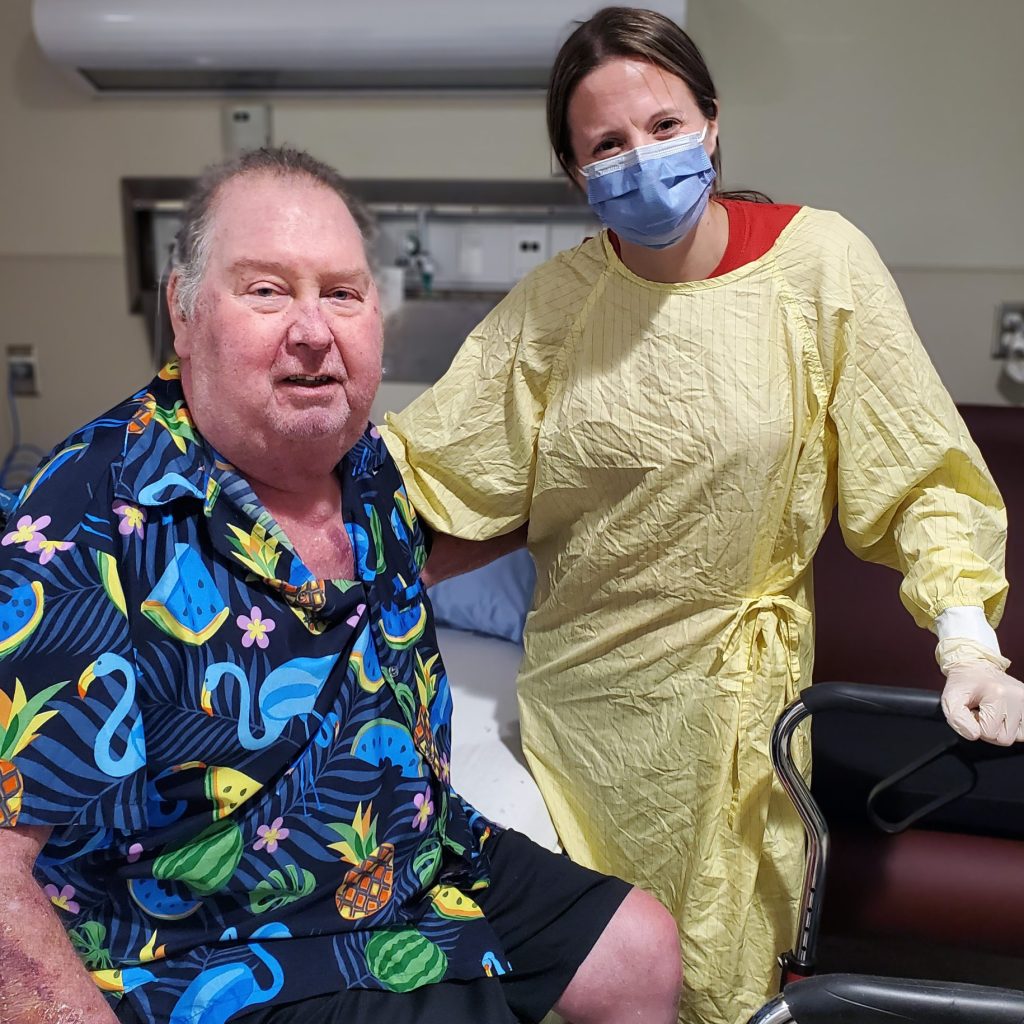
Another patient benefiting from the Reactivation Care Centre is Jeff Dumoulin (pictured). A 65-year-old horse trainer, Jeff was injured in an accident with one of his horses in 2022. The incident left him with long-lasting mobility challenges, leading to frequent stays in the hospital.

“I’ve been in and out of the hospital. Every time I return home, I end up falling and coming right back,” Jeff shares. “I was trying, but I needed more support.”

When Jeff found out that he had a spot in the new Reactivation Care Centre, he felt hopeful.

“The minute I walked in the door, the staff had a plan,” says Jeff. “This is the difference of whether I go home and can walk up and down my stairs again. Everyone in my life realizes I’m getting the help I need to get back to living a functional life.”

Stories like Jeff’s are made possible by the generosity of donors who understand the importance of world-class care, close to home. Thanks to their support, $400,000 in funding was provided to the Reactivation Care Centre through the PRHC Foundation’s Campaign for PRHC.

“One of the focus areas for the campaign is to address urgent needs at the hospital as they arise,” says Lesley Heighway, President & CEO of PRHC Foundation. She explains that ‘undesignated’ gifts to the Foundation can be directed to the highest priority need, which enables a quick response to the hospital’s most pressing requests. “So it’s you, donors, who enabled us to fund critical equipment such as patient beds, vital signs monitors, and specialized wheelchairs for the Centre,” she says.

“With these gifts you’re empowering us to do what the hospital needs, quickly, when they need it. Your support is truly reimagining healthcare. Thank you!”

For more information or to donate, please call 705-876-5000 or click here.

PRHC designated a Level III Trauma Centre

Earlier this year, Peterborough Regional Health Centre received official designation as a Level III Trauma Centre. As a result, the hospital now has a recognized trauma program that, for the first time, is part of the provincial network, with access to its resources. A PRHC trauma director and team have been appointed to further develop PRHC’s trauma system.

Continue reading